
In Depth Guide to Comparing Membership Fee Costs


How to Compare Membership Fees by Total Cost
To compare membership fees, start with the first-year total: 12 months of dues, plus any joining fee, required annual charges, and paid extras. Then check what each plan includes and how much notice you must give to cancel. A lower monthly rate may cost more if it comes with extra fees or benefits you would have to buy separately.
For gym owners, this same comparison is a useful test of pricing clarity. Members should be able to see what they pay upfront, what repeats, and what changes when they add a person or move to another tier.
I’m Eric A. Speer, owner and CEO of Club Systems. After nearly three decades working with fitness facilities, I’ve seen how clear membership fees and reliable dues collection help owners manage their businesses and help members understand their costs.

How Membership Fees Vary by Organization Type
Membership dues exist across a broad spectrum of industries, ranging from neighborhood fitness clubs and commercial gym chains to international professional societies and trade unions. While the core objective of a membership model is recurring revenue in exchange for ongoing value, the mechanics of how dues are structured vary substantially.
In the fitness and wellness industry, dues typically follow predictable monthly or annual cycles. Commercial health clubs often feature multi-tier pricing models designed to serve both budget-conscious gym-goers and premium fitness enthusiasts. In contrast, professional associations and labor unions often structure their dues around individual income levels, organizational revenue, or regional economic conditions.
Understanding the different types of gym pricing models and organizational fee structures helps both consumers evaluating a contract and business owners auditing their pricing strategy.
| Organization / Entity | Typical Joining / Initiation Fee | Standard Recurring Dues | Pricing Determinants / Tiers | Key Inclusions & Perks |
|---|---|---|---|---|
| Budget Gyms (e.g., Planet Fitness) | $0 – $59 (promotional dependent) | $15 – $25 / month | Classic vs. Premium tiers (e.g., PF Black Card®) | Nationwide/worldwide access, guest privileges, recovery amenities |
| Community Nonprofits (e.g., YMCA of High Point) | $50 one-time fee | $62 / month (first adult), +$25/adult, +$12/child | Household size, age brackets (youth, teen, senior) | Full facility access, pool, youth programs, sliding-scale assistance |
| Hospital / Wellness Centers (e.g., UNC Wellness) | $0 – $100 (promotions common) | $93 / month (individual), $166 / month (couples) | Individual, couple, dependent ($28/mo), employee rates | Multi-facility reciprocity across 5 centers, clinical fitness staff |
| Professional Trade Orgs (e.g., CMAA) | $0 | $950 / year (standard professional dues) | Number of members per club, tenure (new vs. rejoining) | Industry research, networking, leadership certifications |
| Labor Unions (e.g., SAG-AFTRA) | $3,000 national initiation fee | $236.60 / year base + 1.575% work dues | Base fee + percentage of covered earnings (up to $1M) | Collective bargaining, contract enforcement, pension/health eligibility |
| International Societies (e.g., Toastmasters) | $25 USD new member fee | $72 USD per 6-month cycle ($144 / year) | Fixed semi-annual dues, prorated for mid-cycle joins | Pathways educational curriculum, public speaking credentials |
For instance, national organizations such as the Club Management Association of America outline a tiered system where professional member dues are $950 per year for the first and second members from a facility, dropping down to $750 for third and subsequent managers from the same club. Reviewing the complete Dues Structure | CMAA highlights how institutional scale directly impacts per-member costs.
Comparing Base Dues and Tiered Membership Fees
Most modern fitness clubs and health centers offer tiered packages rather than a single flat rate. A classic tier provides foundational access to strength equipment and cardio machines at a single home location, often starting as low as $15 per month.
Premium tiers—such as the PF Black Card® or club all-access passports—unlock expanded value. For an increased monthly rate, members gain access to thousands of locations worldwide, reciprocal guest privileges (allowing a friend to work out for free every visit), and specialized recovery amenities like HydroMassage, tanning, and wellness pods.

When evaluating tiered fees, consumers consider household dynamics as well. Community facilities like the YMCA of High Point set adult rates at $62 per month, but add spouses for $25 and children for $12, making a family package far more economical than separate individual accounts. Similarly, UNC Wellness Centers offer standard individual plans at $93 per month, couples plans at $166 per month, and dependents at $28 per month.
Understanding these variables mirrors the primary factors people evaluate in membership selection, where location flexibility, amenities, and total household cost dictate value.
Professional Associations, Unions, and Nonprofits
Professional bodies and labor unions calculate membership dues using entirely different benchmarks, such as earnings capacity, organizational revenue, and geography.
- Labor Unions: Unions like SAG-AFTRA combine a substantial upfront entry cost with earnings-based maintenance. New members pay a $3,000 national initiation fee, coupled with annual base dues of $236.60 and work dues calculated at 1.575% of covered earnings up to $1,000,000.
- Socioeconomic & Geographic Models: The Latin American Studies Association (LASA) utilizes a two-dimensional matrix based on the UN Human Development Index and World Bank income classifications. Regular members pay between $122 and $715 depending on income and country category, with an all-access option that bundles conference registration for greater overall savings. Lifetime memberships are capped at $3,900.
- Revenue-Based Dues: The U.S. Green Building Council (USGBC) charges individuals $129 per year, while organizational dues scale from hundreds to over $20,000 based on sector and annual business revenue.
- Global Professional Standards: As detailed in the STEP Membership Fees Guide, full annual subscriptions vary significantly by jurisdiction—ranging from GBP 470 to GBP 865 in the UK and Europe, or approximately USD 540 in the United States. In many regions like the UK, these professional dues are recognized for tax relief.
- Fixed Semi-Annual Structures: According to official Toastmasters Dues and Payment Policies, international dues are set at $72 USD every six months (due April 1 and October 1), with prorated schedules for members joining mid-cycle ($12 per remaining month).
One-Time Upfront Costs and Payment Methods
Beyond recurring base dues, many organizations require one-time fees upon enrollment. These charges offset administrative onboarding, member profile setup, physical access key fobs, and system credentialing.
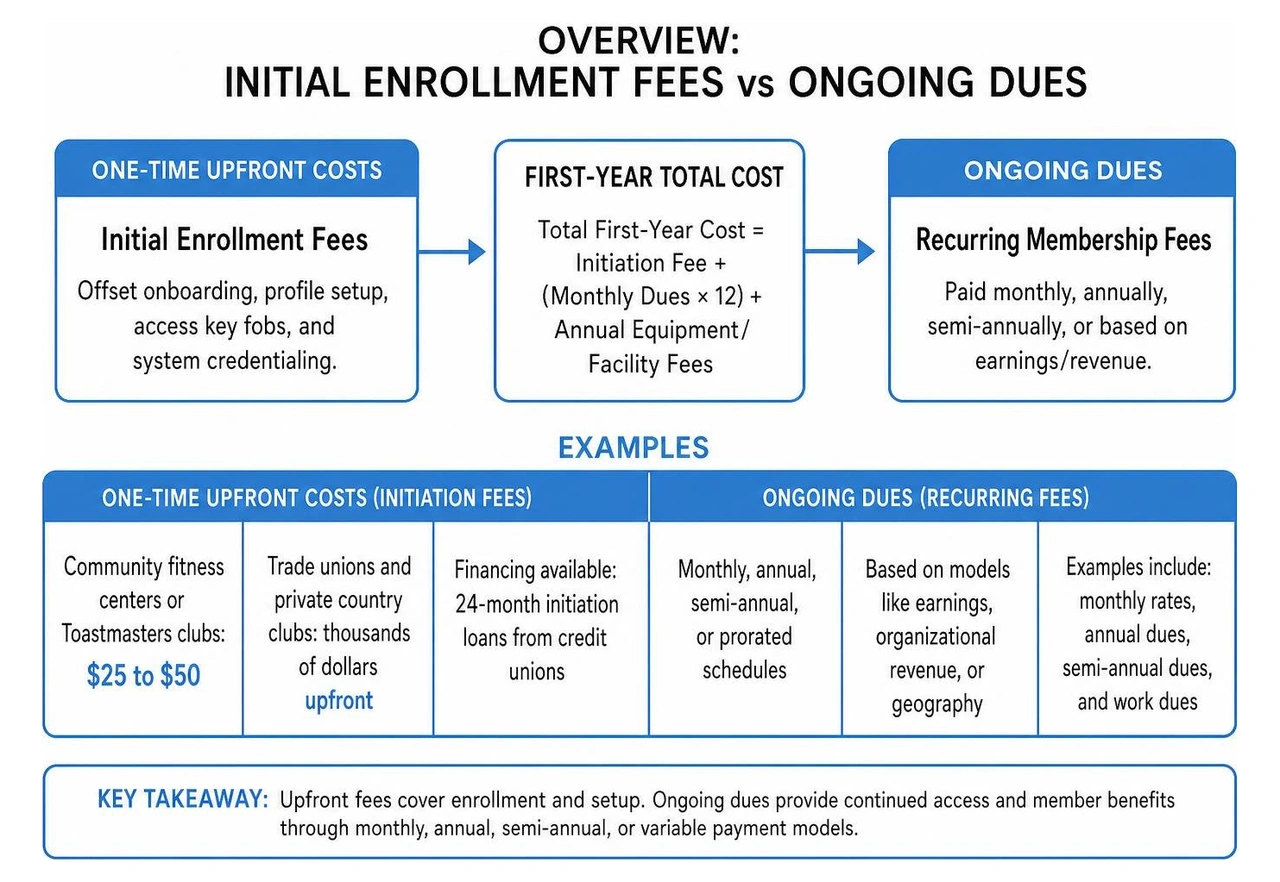
Initiation charges vary widely across sectors. While a community fitness center or Toastmasters club may charge a modest $25 to $50 administrative fee, trade unions and private country clubs can require thousands of dollars upfront. To manage these significant initial costs, specialized financing exists; for example, the SAG-AFTRA Federal Credit Union and Actors Federal Credit Union provide dedicated 24-month initiation loans to assist new members with entry fees.
Initiation Dues vs Ongoing Membership Fees
Facility operators frequently use promotions to reduce friction for prospective members. UNC Wellness Centers frequently run campaigns featuring a $0 enrollment fee alongside a free trial period for first-time or returning members whose accounts have been inactive for at least six months.
For clubs, offering structured, customized membership plans helps balance predictable recurring revenue with low-barrier onboarding. Additionally, utilizing trial memberships gives prospective members hands-on experience with equipment, staff, and classes before committing to initiation costs and ongoing contracts.
Payment Processing Options and Billing Cycles
How an organization collects membership dues plays a critical role in cash flow stability and member satisfaction. The most common payment methods include:
- Electronic Funds Transfer (EFT / ACH Bank Draft): Automated bank drafts pull directly from checking accounts. Because routing and account numbers rarely change (unlike debit or credit cards that expire or get replaced), EFT provides gym owners with high collection reliability and low processing fees.
- Recurring Credit and Debit Card Billing: Convenient for consumers who want to earn card reward points, though subject to higher interchange fees and involuntary churn from expired card numbers.
- Annual / Semi-Annual Prepayment: Upfront payment for 6 or 12 months. Toastmasters allows members to use a Self-Pay portal to pay for their current period and up to two future six-month periods simultaneously.
- Cash Discount Programs: Modern billing systems allow businesses to offer discounts to members paying via direct bank debit or cash, offsetting third-party merchant processing surcharges.
Facility managers can explore what gym owners need to know about EFT payments to minimize failed transactions. Ensuring smooth billing mechanisms highlights the operational benefits of automatic membership payments, which keep member accounts current without requiring monthly staff intervention.
Membership Discounts, Cancellation Rules, and Hidden Costs
Discounts are widely used to make memberships accessible across diverse demographic groups. Common rate reductions include:
- Senior Discounts: The Carl & Linda Grubb Family YMCA provides a $10 monthly discount on the primary adult rate for members aged 65 and older.
- Young Adult & Student Pricing: Emerging professionals and students often receive discounted rates. USGBC reduces standard $129 individual dues to $79 for emerging professionals and $59 for students, while CMAA offers student dues for just $25 annually.
- Corporate & Group Rates: Companies with multiple participating employees often qualify for subsidised rates. UNC Wellness Centers discount individual dues from $93 to $80 per month for hospital and university employees.
- Financial Aid & Sliding Scales: Nonprofit wellness organizations provide income-based adjustments. Programs like the YMCA's Y For You evaluate recent tax returns and household income to place qualifying members on a reduced-cost sliding scale.
Renewal Terms, Cancellation Notices, and Refund Policies
Understanding the fine print regarding renewals and cancellations is essential to calculating total membership costs.

Many health clubs and wellness centers operate on month-to-month contracts that require a written 30-day notice to terminate without penalty. In contrast, term agreements with minimum commitments (such as 12-month plans) may impose early buyout fees if canceled before the term expires.
Refund policies also vary: professional societies like Toastmasters enforce strict non-refundable and non-transferable dues policies, whereas fitness clubs often review billing disputes on a case-by-case basis.
When billing policies are rigid, confusing, or prone to processing errors, member satisfaction plummets. Ensuring transparent payment schedules prevents scenarios where a gym's billing systems impact on member retention leads to unnecessary member cancellations.
Value Analysis: Amenities and Resources vs Total Cost
A higher base membership fee is often justified when the plan bundles services that would otherwise require individual out-of-pocket purchases.
Consider what is included in standard versus premium pricing structures:
- Equipment & Group Fitness: Routine access to state-of-the-art machines, free weights, and complimentary group training sessions led by certified staff.
- Multi-Location Reciprocity: Access to regional or global networks, such as UNC Wellness Center's reciprocal access across all five regional facilities or Planet Fitness Black Card's access to 2,900+ clubs worldwide.
- Guest Privileges: The ability to bring a workout partner on every visit provides substantial financial value for households or workout partners who split gym commitments.
- Educational Pathways: Professional organizations incorporate valuable resources, such as Toastmasters' Pathways online education curriculum or CMAA's executive certification programs.
Evaluating what to expect from modern billing systems helps facility owners deliver seamless member access, POS management, and automated check-ins that validate membership value every single day.
Frequently Asked Questions About Membership Costs
Are one-time enrollment fees negotiable or ever waived?
Yes. Many fitness facilities run seasonal enrollment promotions—particularly in January, late spring, or late summer—that waive the initial joining fee entirely. Furthermore, university-affiliated and community wellness centers often waive initiation fees for corporate partners, alumni, or returning members who rejoin after a defined lapse period.
What happens if a membership renewal payment is missed?
Consequences depend on the organization type. Professional associations like Toastmasters provide a brief grace period to maintain active credentials and portal access (with payments due on April 1 and October 1, required by March 31 / September 30 to prevent system disruption), without charging late fees. Fitness facilities typically attempt automated payment retries via EFT or credit card; unresolved balances may incur small administrative decline fees or temporary suspension of facility entry until the dues balance is resolved.
How do organizations calculate income-based or sliding-scale fees?
Nonprofit community centers (such as the YMCA) and academic associations (such as LASA) establish fee tiers based on gross household income or international socioeconomic classifications. To qualify for community assistance, applicants generally submit documentation such as a recent tax return, W-2 form, or government assistance verification to place the household in the appropriate sliding-scale bracket.
Conclusion
Comparing membership fees requires looking past headline monthly rates to evaluate one-time initiation charges, billing cycles, cancellation terms, and included perks. Whether you are a consumer choosing the right club tier or an organization setting up a sustainable dues structure, transparent pricing creates long-term trust and consistency.
At Club Systems, we support fitness facility owners with integrated club management software designed to simplify operations. From high-collection-rate dues processing and cash-discount merchant programs to 24/7 access control and responsive US-based support, our tools keep billing efficient and reliable. Discover how membership fees can boost your business profits while delivering clear, transparent value to every member who walks through your doors.
Tired of Struggling with Your Gym's Software?
Simplify your operations, save money, and get the support you need with Club Systems.