
A Practical Guide to Comparing Gym Payment Processors


How to Compare Gym Payment Processing Options
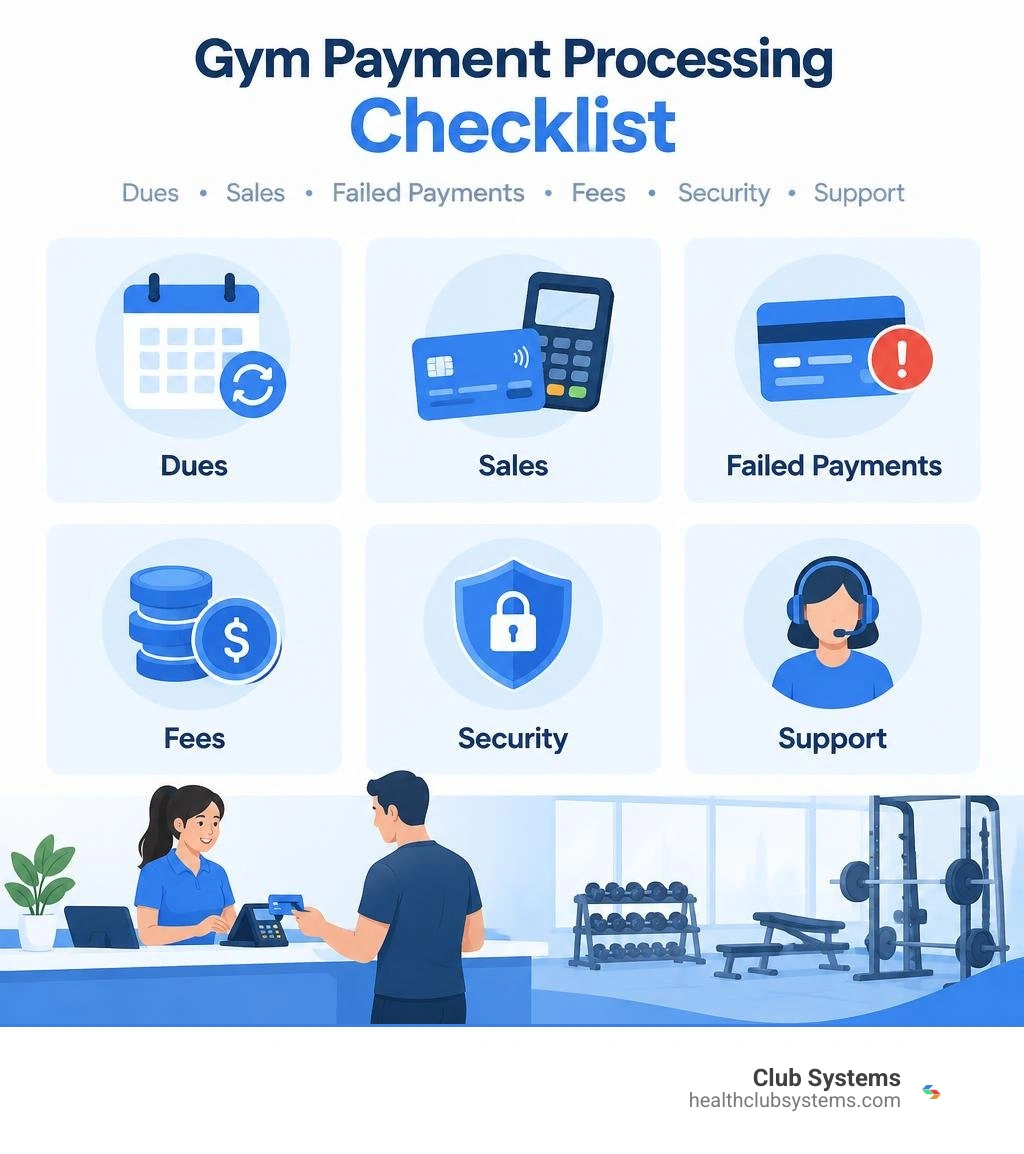
The right gym payment processing setup should collect recurring dues, handle front-desk sales, and make billing easy for members to understand. When comparing options, check how each one handles failed payments, cancellations, payment security, software integration, and support. Ask for a full fee schedule, not just a card rate.
A low rate means less if missed dues go uncollected or staff must fix billing problems by hand. Look at the whole payment workflow before you decide.
I'm Eric A. Speer, owner and CEO of Club Systems. Since joining the company in 1995, I've worked with gym management and billing tools, including gym payment processing; here's the checklist I'd use to compare them.
Core Features to Look for in Modern Gym Payment Processing
Running a fitness facility involves managing active memberships, retail items, drop-ins, and personal training packages. Selecting the proper merchant services and payment gateway infrastructure directly dictates whether your cash flow runs predictably or gets bogged down in manual reconciliation.
When evaluating solutions, your setup must comply with the Payment Card Industry Data Security Standard (PCI-DSS). Instead of storing sensitive raw credit card numbers on your local computers, modern systems utilize end-to-end encryption and tokenization. A token replaces sensitive card information with an unreadable string of characters, meaning your gym never holds vulnerable data that bad actors could exploit. To safeguard your business and members, review standard security practices like the official Small Merchant Guide to Safe Payments alongside dedicated tools like dues processing.
Beyond data protection, the right setup balances reliable automation with responsive member support. Let’s break down the two primary operational engines your gym relies on every day: recurring dues and retail sales.
Automated Dues and Recurring EFT Management
Recurring revenue forms the foundation of every stable health club. Today, credit cards account for over 60% of fitness industry transactions, but relying solely on manual card swipes wastes hours of staff time. Gyms that adopt automated recurring billing see a 20% to 30% increase in member retention compared to facilities using manual collection methods.
Automating these workflows requires robust Electronic Funds Transfer (EFT) capabilities. You can explore what gym owners need to know about EFT payments to see how direct debit and ACH transfers pull funds directly from a member’s bank account. Bank-to-bank transfers typically carry lower transaction fees than credit cards and never face physical card expiration dates.
A modern setup utilizing recurring EFT allows you to:
- Schedule dynamic billing cycles (weekly, bi-weekly, monthly, or annually).
- Store secure card-on-file details for seamless recurring dues.
- Automate mid-cycle membership upgrades or prorated dues adjustments.
Front-Desk and Retail Point of Sale Capabilities
Your front desk is where member relationships are built, but it is also a vital revenue center. A processor must handle more than just monthly dues—it needs to support fast, reliable transactions at the counter.
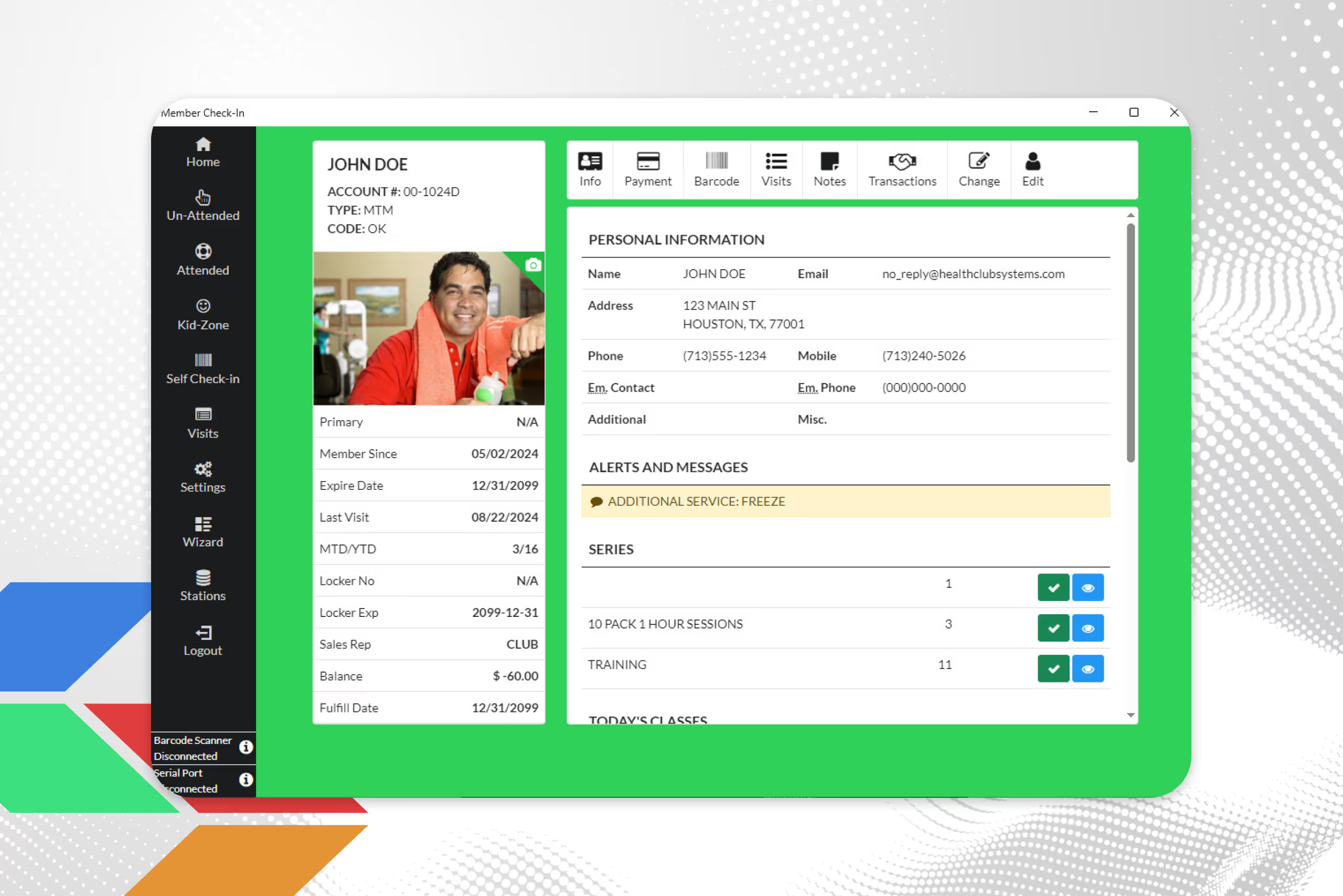
An integrated point of sale system allows your staff to quickly sell beverages, apparel, supplements, and drop-in passes without toggling between separate terminal software. Look for hardware compatibility that includes barcode scanners, receipt printers, and point of sale peripherals alongside contactless tap-to-pay terminals.
Additionally, your software should manage series sales and class packs. When a member buys a 10-pack of personal training sessions or yoga classes, the system must automatically track usage and debit sessions directly upon check-in.
All-in-One Management Platforms vs. Standalone Processors
Many gym owners weigh using a standalone payment terminal from a traditional merchant bank against choosing an integrated gym management platform. While a standalone terminal might offer attractive introductory rates on paper, it often creates operational headaches behind the desk.
| Operational Area | Integrated All-in-One Platform | Standalone Payment Processor |
|---|---|---|
| Member Records | Automatically synchronized with payment history. | Disconnected; requires manual double-entry. |
| Access Control | Instantly revokes door access upon failed payment. | Manual; staff must cross-check dues reports. |
| Failed Payment Handling | Automated retries, text alerts, and account updater. | Manual phone calls and invoice generation. |
| Retail Sales | POS updates inventory and member ledger instantly. | Separate batch settlement and external records. |
| Administrative Overhead | Minimal; centralized reporting in one hub. | High; reconciliation across disparate systems. |
Relying on disconnected systems creates data fragmentation. For instance, when choosing between modern billing systems for gyms, an integrated approach ensures that when a member updates their credit card online, their 24/7 barcode scanner immediately lets them through the front turnstile.
How Dedicated Gym Payment Processing Protects Revenue from Involuntary Churn
Member churn breaks down into two categories: voluntary (deciding to cancel) and involuntary (unintended payment failures). Across the industry, failed payment attempts cost the average gym between 5% and 10% of its monthly recurring revenue.
Cards expire, banks update fraud algorithms, and credit limits get reached. If your system cannot handle soft declines, you risk losing paying members without realizing it.
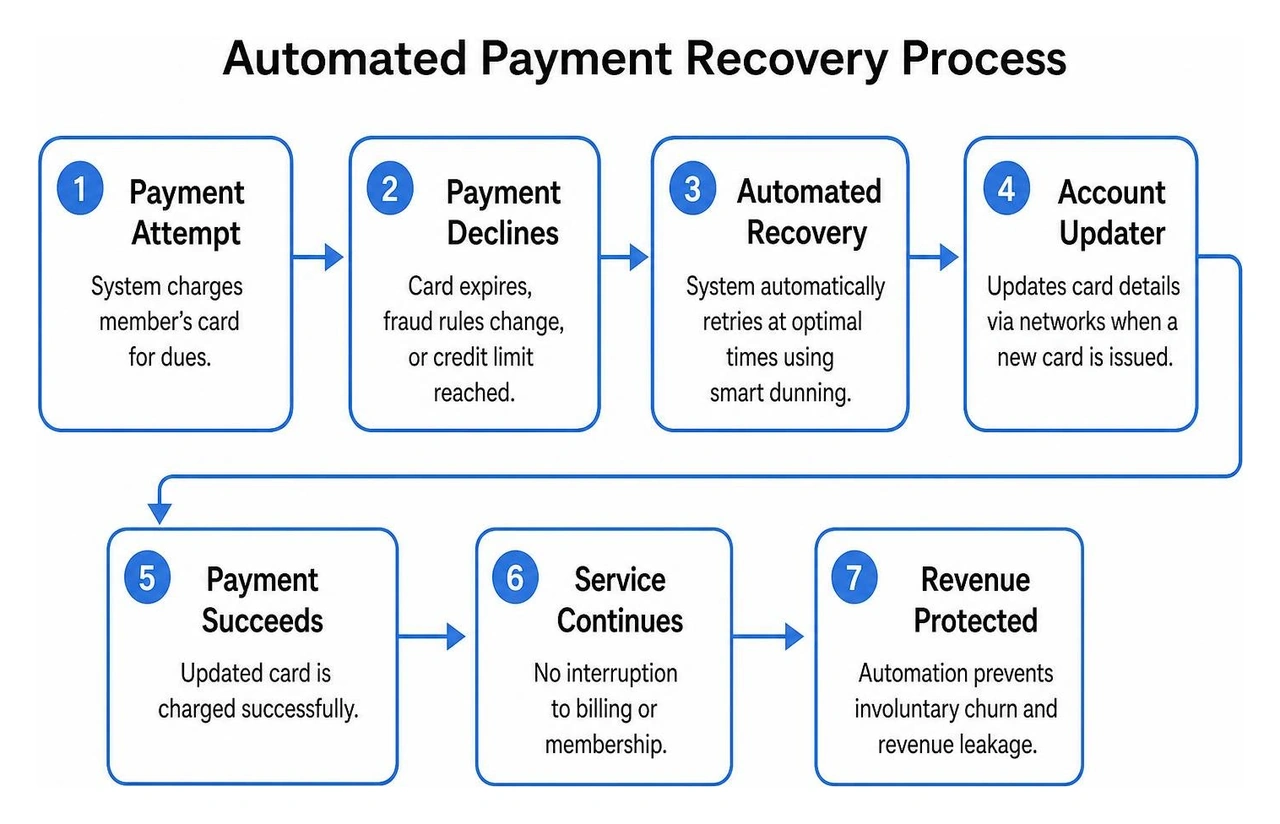
An integrated dues tool uses an automated account updater to communicate directly with card networks (Visa, Mastercard, Discover, American Express). When a member receives a newly reissued card due to expiration or loss, the network updates the token behind the scenes without interrupting billing cycles. Paired with intelligent dunning sequences that automatically retry failed cards at optimal times, smart automation stops revenue leakage in its tracks.
Member Experience and Retention Impact
About 45% of gym members cancel their memberships within the first six months. While workout frequency plays a role, confusing bills and unexpected fees cause significant early drop-off.
Understanding how billing systems impact customer experience is crucial. When members encounter unexpected line items, double billings, or rigid payment schedules, they become frustrated. If you suspect friction in your current checkout, ask yourself is your billing system hurting retention rates?
Providing transparent invoices through a modern member portal allows patrons to view their purchase history, update stored payment methods, and manage their add-ons easily. When billing runs smoothly, members can focus on their fitness goals instead of payment errors.
Managing Failed Payments, Chargebacks, and Collections
Even with card updater tools, payments can occasionally decline due to non-sufficient funds (NSF) or closed accounts. Fitness businesses average a chargeback rate of around 0.5%, often fueled by "friendly fraud"—situations where a member forgets an automatic renewal and initiates a dispute with their credit card company rather than reaching out directly.
Resolving disputes requires swift action and verifiable records. Your payment system should log electronic signatures, timestamped waivers, check-in history, and signed membership agreements. Using tools like X-Capture digital contract storage makes it easy to submit compelling evidence to card brands during a dispute.
When dues go unpaid for extended periods, staff shouldn't spend their workday playing debt collector. Professional delinquent dues collections recover lost revenue through structured, compliant outreach, preserving your staff's time and maintaining positive relationships at the front desk.
Evaluating Fee Structures and Gym Payment Processing Rates
Payment processing contracts can be filled with hidden fees, statement surcharges, and confusing rate structures. Finding the right option requires comparing standard merchant models:
| Pricing Model | How It Works | Best Suited For | Pros & Cons |
|---|---|---|---|
| Flat-Rate Pricing | A fixed percentage plus per-transaction fee (e.g., 2.9% + $0.30). | Low-volume studios or micro-gyms. | Pro: Predictable. Con: Often more expensive for high-volume dues. |
| Interchange-Plus | Exact card network interchange rate passed through + a small fixed markup. | Mid-sized to large fitness facilities. | Pro: Complete transparency. Con: Statements vary monthly based on card types. |
| Cash Discounting | Posted prices reflect cash/debit; a small non-cash fee covers card processing. | High-traffic clubs seeking to lower merchant costs. | Pro: Drastically reduces merchant fees. Con: Requires clear counter signage and staff training. |
If you are looking to maximize your margins, adopting cash discount programs can offset significant credit card transaction overhead. At the same time, exploring the benefits of a flat fee billing service ensures your business scales without surrendering an ever-growing percentage of dues to software processors.
Offering flexible gym pricing models—such as annual pre-pays, bi-weekly auto-pays, and class packages—gives members options that fit their personal finances while keeping your recurring income steady.
Frequently Asked Questions About Gym Payment Processing
What causes high payment failure rates at fitness facilities?
The most frequent culprits behind payment failures are expired card dates, changes in billing addresses, temporary credit limit caps, and anti-fraud filters triggered by recurring subscription transactions. Implementing an automated account updater and recurring ACH billing addresses the majority of these soft declines.
How does PCI compliance work for gym payment processors?
PCI compliance involves adhering to operational and technical standards set by the major payment card brands. Certified gym payment software secures member payment details using hosted tokenization vaults, keeping cardholder data isolated from your local gym computers and greatly reducing your annual PCI auditing complexity.
What is the most cost-effective payment method for gym memberships?
ACH (Automated Clearing House) and direct debit transfers are typically the most cost-effective methods for collecting ongoing dues. Because they bypass interchange card network fees, ACH transactions often cost pennies compared to the 2% to 3.5% commonly charged on credit card transactions. Cash discount programs are another effective way to keep operational costs low.
Conclusion
Managing gym cash flow should never be an uphill battle. When your dues collection, front-desk point of sale, access control, and payment recovery run on an integrated platform, you eliminate revenue leakage and protect your monthly cash flow.
At Club Systems, we specialize in high-collection-rate dues processing, cash-discount merchant options, and dedicated, real-person support based in the United States. Take control of your facility's financial future by scheduling a demo of our integrated gym management software suite today.
Tired of Struggling with Your Gym's Software?
Simplify your operations, save money, and get the support you need with Club Systems.