
A Gym Owner's Guide to Lowering Merchant Account Rates


How to Lower Fitness Center Credit Card Processing Costs
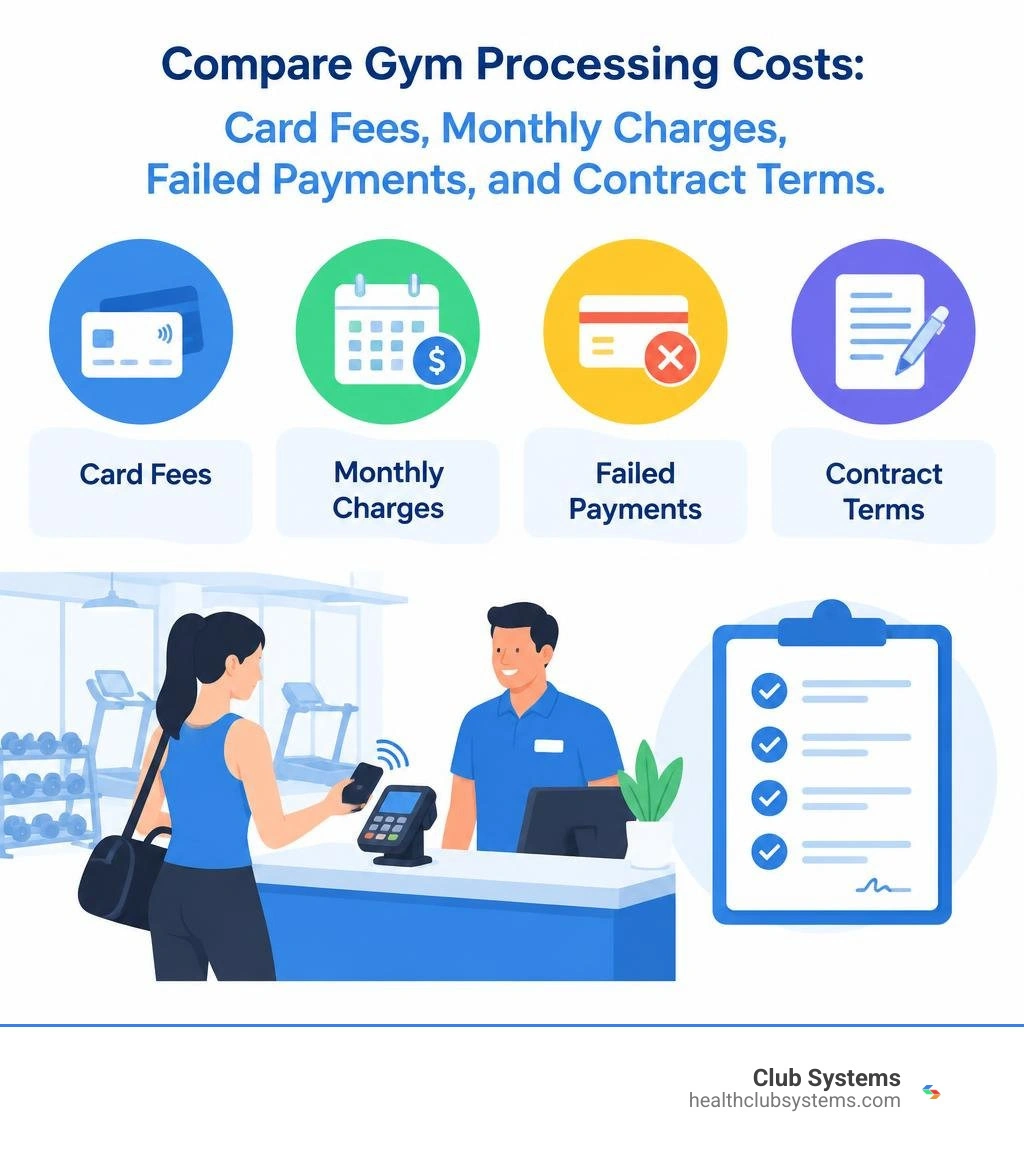
To lower fitness center credit card processing costs, compare the total cost of each merchant account, not just its advertised rate. Add up card fees, monthly charges, and the cost of failed payments. Then check whether the processor works with your gym software and supports recurring dues, class payments, and in-club sales. A low rate is less useful if billing errors or hard-to-spot fees eat into your savings.
Start with a recent processing statement. Look at what you paid, what you collected, and which fees you could avoid or negotiate. This guide will help you compare pricing models and spot contract terms that deserve a closer look.
I'm Eric A. Speer, owner and CEO of Club Systems. Since joining the company in 1995, I've worked on gym management and dues processing, giving me a close view of the billing challenges behind fitness center credit card processing.
Why Fitness Center Credit Card Processing Differs from Standard Retail
Operating a gym comes with unique operational demands. Unlike a standard retail boutique where a customer buys a shirt, swipes their card, and walks out the door, health clubs operate primarily on recurring subscriptions. This fundamental difference exposes fitness facilities to distinctive chargeback risks, higher rates of seasonal churn, and significant administrative overhead.
In traditional retail, the merchant delivers the product immediately at the point of sale. For fitness clubs, cardholders pay in advance for ongoing access over thirty days, six months, or an entire year. If a member stops attending or forgets they signed an annual contract, their first reaction is often to call their credit card company rather than visit your front desk. This dynamic introduces ongoing dispute liabilities that require specialized billing systems for gyms designed to document member agreements and maintain ironclad audit trails. When setting up automated charges, it is vital to know how automatic payments work under federal consumer protection guidelines so your facility maintains proper authorization records.
In-Club Retail vs. Recurring Membership Dues
Your facility processes two entirely distinct transaction environments every day:
- Card-Present Transactions (In-Club POS): These occur when members purchase smoothies, apparel, or personal training packages at your front desk. Because the customer dips an EMV chip or taps a digital wallet, card brands view these as lower risk, which commands lower interchange rates. Equipping your front counter with a dedicated gym POS system ensures these transactions settle instantly at the lowest possible rates.
- Card-Not-Present Transactions (Recurring Dues): Recurring monthly fees pull payments automatically without the physical card present. Even though you swiped the card when the member joined, future automated runs are classified as card-not-present (CNP), carrying higher interchange fees and greater fraud risk. Handling these recurring payments requires dedicated dues processing infrastructure capable of vaulting tokens safely and handling monthly batches smoothly.
Involuntary Churn and Card Expiration Issues
One of the largest hidden drains on gym revenue is involuntary churn. Every month, members lose cards, banks issue new chips due to data breaches, and expiration dates roll over. When recurring billing runs, these outdated profiles return "soft declines."
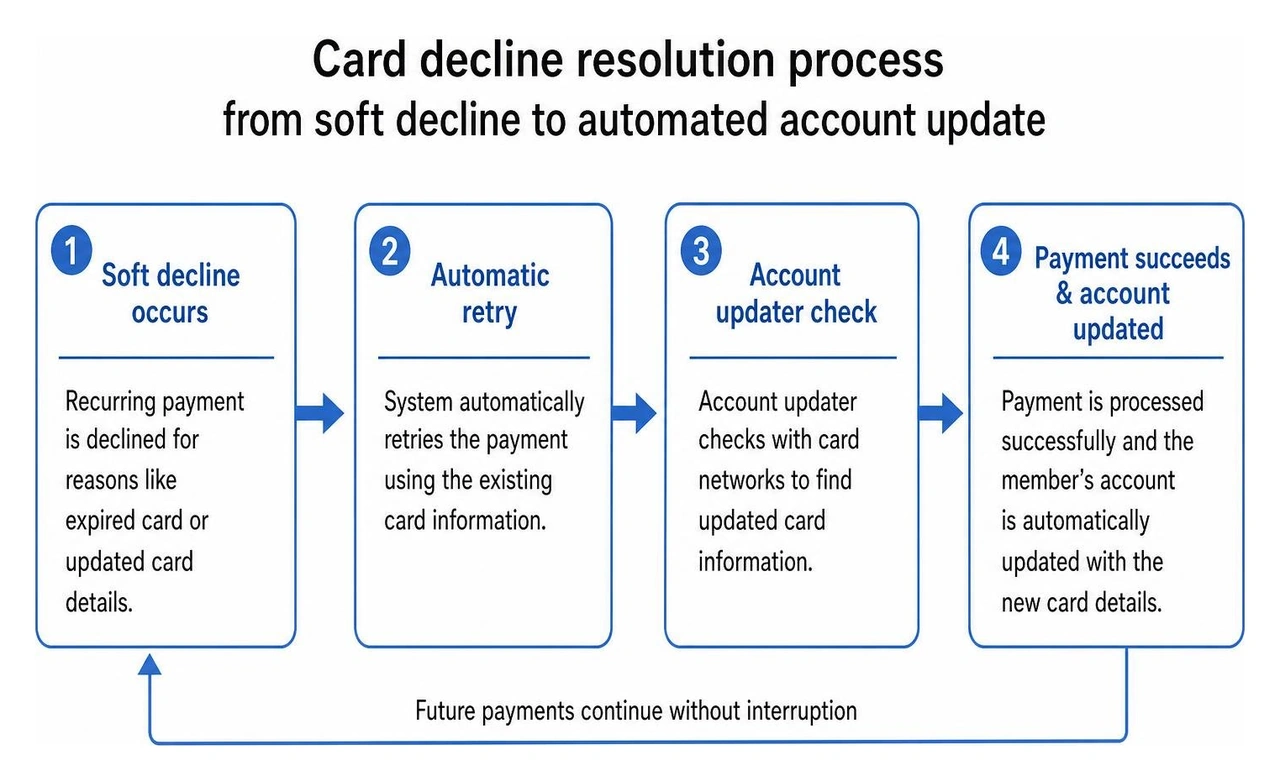
Without automated billing tools, your front desk staff must spend hours making uncomfortable phone calls to collect updated card details. Implementing automated account updater tools solves this by communicating directly with card networks behind the scenes, seamlessly refreshing expired card numbers and dates before your billing cycle triggers. Using these tools is one of the most effective strategies for avoiding missed payments and protecting member lifetime value.
Comparing Merchant Pricing Models for Health Clubs
Payment processors present their pricing structures through several models. The differences between these models directly dictate your monthly bottom line and profit margins. Understanding the processor markup over underlying network assessment fees is essential for optimizing cash flow in your facility.
| Pricing Model | How Rates Are Calculated | Best Suited For | Pros | Cons |
|---|---|---|---|---|
| Flat-Rate | Fixed percentage plus per-transaction fee (e.g., 2.9% + $0.30) on all charges | Micro-gyms, pop-ups, low monthly volume (<$10k/mo) | Predictable, simple line-item reconciliation | Expensive for high-volume gyms; cushions high processor margins |
| Tiered Pricing | Transactions bucketed into Qualified, Mid-Qualified, and Non-Qualified | Legacy merchant providers | Appears simple on initial marketing materials | Highly opaque; most rewards and corporate cards fall into pricey non-qualified tiers |
| Interchange-Plus | Exact wholesale interchange passed through, plus a transparent fixed fee (e.g., Interchange + 0.20% + $0.10) | Mid-to-large fitness clubs and health clubs | Fully transparent; lowest cost for high transaction volumes | Statements can look complex with detailed interchange line items |
| Cash Discount | Posted prices reflect card cost; members paying with cash or direct transfer receive a built-in discount | Gyms wanting to eliminate processing overhead entirely | Offsets up to 100% of processing fees legally and transparently | Requires proper terminal signage and clear customer communication |
Flat-Rate vs. Tiered Pricing Pitfalls
Flat-rate models offer surface-level simplicity, but you pay a premium for that convenience. If a basic debit card carries a wholesale interchange fee of just 0.05% plus $0.21, but your flat-rate processor charges you 2.89% plus $0.20, the processor pockets a huge profit margin on every recurring debit payment.
Tiered pricing can be even more deceptive. Processors advertise an attractive "Qualified" rate (such as 1.49%), but bury fine print dictating which cards qualify. In reality, almost all modern credit cards—including rewards cards, airline cards, business credit cards, and card-not-present recurring transactions—are downgraded to "Mid-Qualified" or "Non-Qualified" tiers. This often spikes the actual rate past 3.50% or more. These structures hide unnecessary processing fees that directly erode your operating budget.
Interchange-Plus and Cash Discount Programs
For established facilities, interchange-plus pricing delivers total transparency. You pay the exact wholesale fee charged by the card brand (Visa, Mastercard, Discover, American Express) plus an agreed-upon, fixed markup to your processor. When interchange rates drop or your volume increases, your savings increase immediately.
Alternatively, implementing an automated cash discount program at your front desk and inside your billing engine allows you to eliminate merchant fees on retail and membership lines entirely. Members who choose credit cards cover the transaction cost, while those who pay via direct bank transfers or cash enjoy lower prices.
Strategies to Lower Merchant Processing Fees and Mitigate Risk
Trimming merchant expenses does not require sacrificing processing security. By taking control of dispute procedures, security standards, and payment rails, you can systematically lower your overhead.

Key proactive steps to take include:
- Daily Batch Closures: Settle your point-of-sale terminals every 24 hours. Holding open batches for multiple days leads to downgraded card tiers and higher interchange rates.
- Maintain Current PCI-DSS Compliance: Processors often levy monthly non-compliance penalty fees ranging from $20 to $100 if you fail to complete your annual self-assessment questionnaire (SAQ).
- Audit Processing Statements Semi-Annually: Check for unannounced rate creeps, new portal fees, or miscellaneous batch charges added quietly to your merchant invoice.
- Diversify Payment Rails: Introduce alternative, low-cost options like direct bank debits through modern EFT payment methods.
Shifting Recurring Dues to Automated Bank Transfers
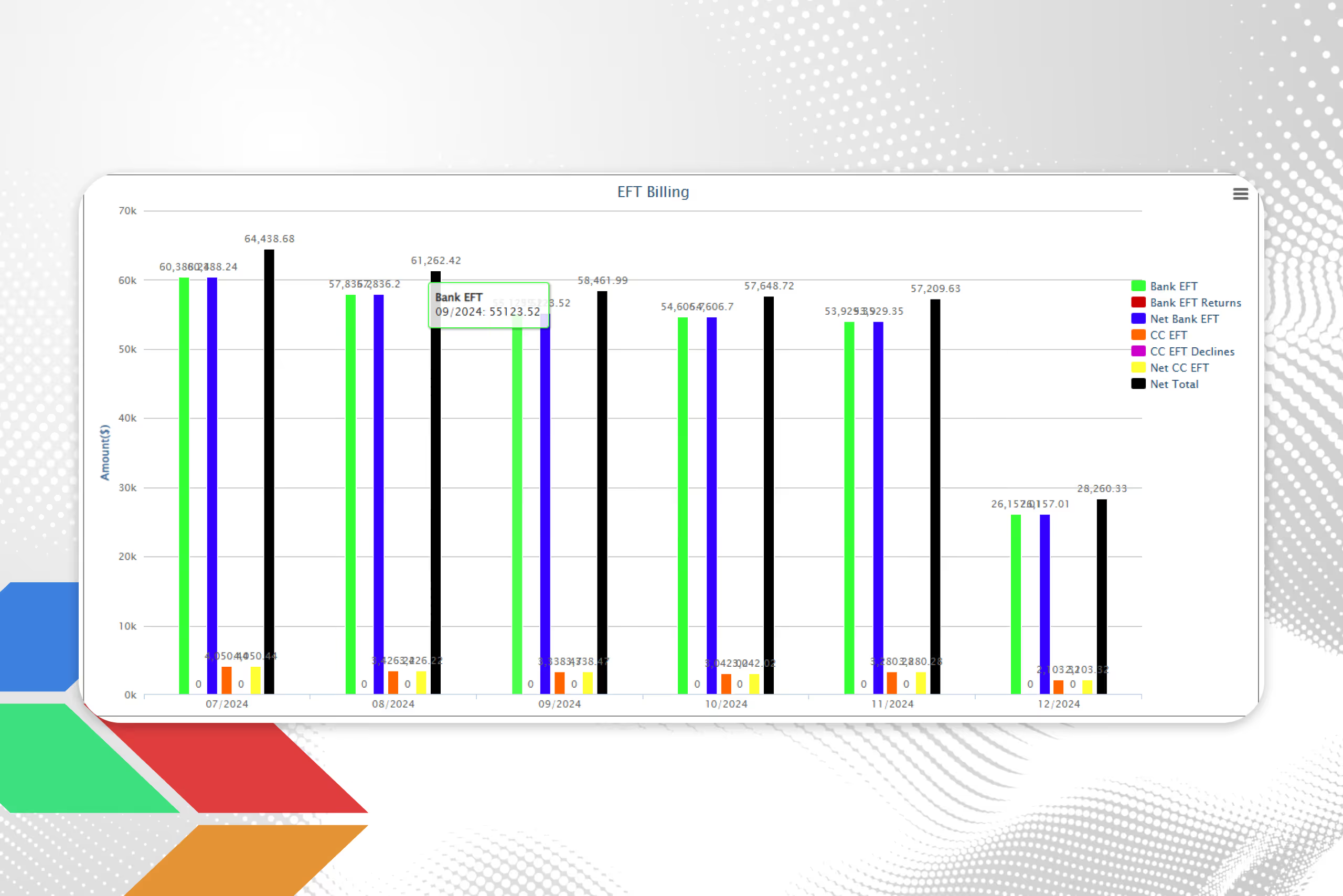
While credit cards will always remain popular with members, direct electronic funds transfers (EFT / ACH) are by far the most cost-effective method for collecting recurring dues.
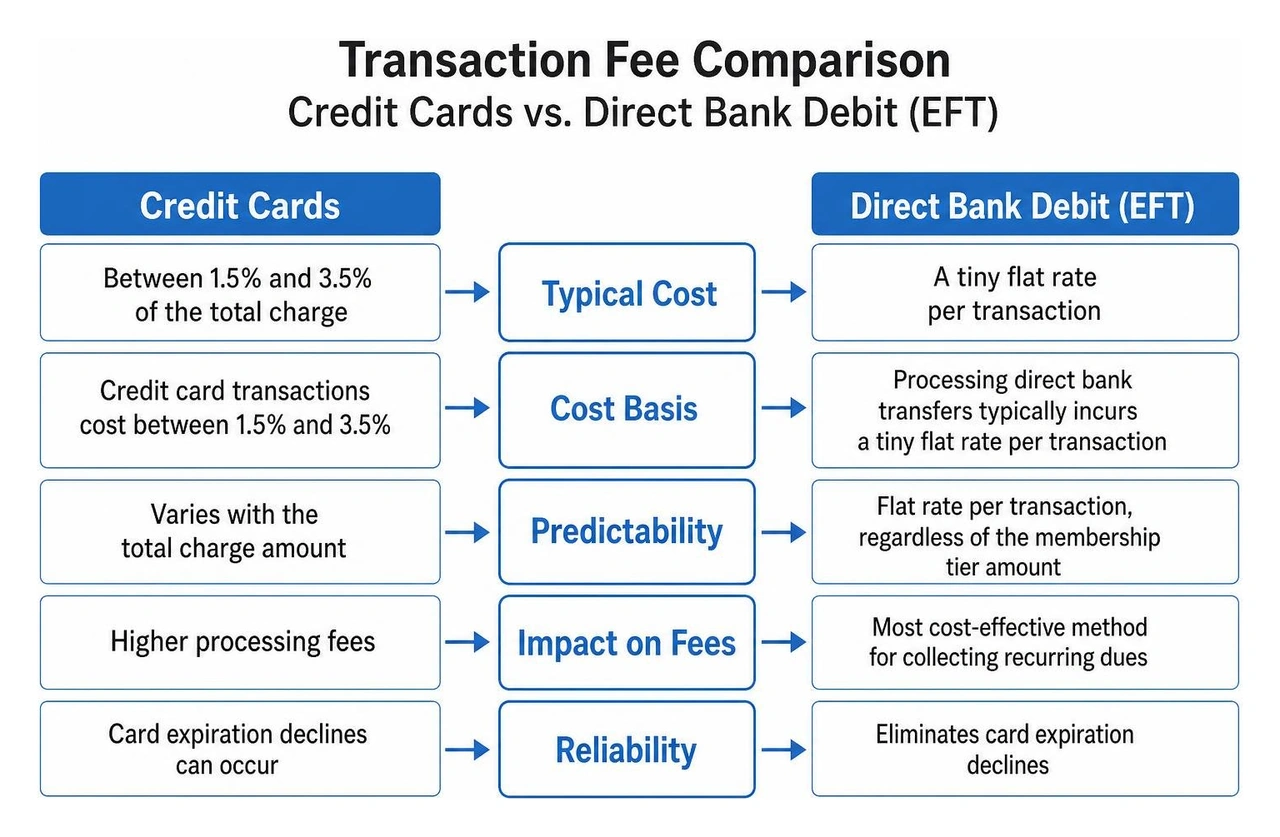
Credit card transactions cost between 1.5% and 3.5% of the total charge. In contrast, processing direct bank transfers typically incurs a tiny flat rate per transaction (often just pennies), regardless of the membership tier amount. Migrating your monthly member base to recurring EFT significantly reduces card processing fees while eliminating card expiration declines. Establishing automatic membership payments tied directly to member checking accounts stabilizes your monthly cash flow and keeps billing smooth year-round.
Hidden Costs in Fitness Center Credit Card Processing Contracts
When reviewing merchant agreements, look out for restrictive fine print:
- Liquidated Damages & Early Termination Fees (ETFs): Some standard merchant providers attempt to lock fitness centers into multi-year contracts featuring steep cancellation penalties calculated by multiplying your average monthly fees across the remaining contract term.
- Inflated Gateway Access Fees: Watch for separate monthly "gateway connection" or "network access" line items on top of standard software and transaction fees.
- Excessive Chargeback Administrative Penalties: Standard chargeback fees range from $15 to $25 per incident. Predatory contracts may charge $50 or more for every disputed claim.
- Paper Statement & Regulatory Compliance Surcharges: These arbitrary line items add zero functional value to your payment operations.
Integrating Payment Gateways with Gym Management Software
Running separate software for member management and payment processing creates messy balance sheets, missed collections, and wasted administrative labor. When front-desk staff have to enter member balances into a standalone credit card terminal and manually record the payment in another program, errors happen.
Achieving full operational efficiency requires your merchant account to integrate natively with your club management system. If you are assessing software, consider whether upgrading your gym POS in 2026 could unify your dues processing, front-desk retail, class bookings, and access control under a single provider. Adopting comprehensive financial management tips begins with building a reliable, unified payment architecture.
Key Technologies in Fitness Center Credit Card Processing
Modern health club management relies on several essential payment technologies:
- End-to-End Payment Tokenization: Instead of saving actual 16-digit credit card numbers on your local computers—which creates massive PCI liability—modern systems convert sensitive account data into encrypted digital tokens. This keeps card data safe while allowing effortless monthly recurring billing.
- Contactless Terminals and Mobile Wallets: Apple Pay, Google Wallet, and tap-to-pay EMV chip cards provide the fastest front-desk checkout experience for day passes, shakes, and merchandise.
- Integrated Hardware Peripherals: Professional front desks require reliable hardware peripherals including barcode scanners, receipt printers, cash drawers, and customer-facing PIN pads that communicate directly with your central billing database.
Automated Debt Recovery and Member Retention
When automated card runs fail due to temporary credit limits, travel freezes, or bank security blocks, manual collections take up valuable time and often frustrate members.
Modern gym billing engines address this using intelligent retry logic. The system retries failed payments at strategic intervals across several days, resolving a large portion of soft declines without staff intervention. For accounts that remain outstanding, integrated delinquent collections follow structured, polite recovery workflows. Managing failed payments diplomatically is essential, as aggressive or uncoordinated recovery efforts have a direct impact on retention rates.
Frequently Asked Questions About Gym Merchant Accounts
What is the most cost-effective pricing model for gym credit card processing?
For gyms generating more than $10,000 to $15,000 per month in billing volume, interchange-plus pricing combined with a cash discount program is the most cost-effective solution. Interchange-plus ensures you pay true wholesale card costs plus a minimal, clearly defined markup. Cash discount programs let members choose their payment method while insulating your club's profit margins from processing overhead.
How can fitness centers prevent membership chargebacks?
To minimize chargebacks:
- Ensure your legal club name or recognizable trade name matches your credit card merchant billing descriptor exactly so members recognize the charge on their bank statements.
- Require digital or physical signatures on all membership agreements, clearly detailing cancellation notice requirements, freeze policies, and recurring billing dates.
- Send automated electronic receipts and billing reminders prior to annual fee assessments or recurring renewals.
- Make your cancellation process straightforward and transparent; members who encounter difficult roadblocks to cancel are far more likely to file an illegitimate fraud dispute with their card issuer.
Why are fitness centers considered high-risk by merchant processors?
Financial institutions classify fitness clubs as higher-risk merchants because they operate on a future-service fulfillment model through recurring subscriptions. If a fitness facility suddenly shuts down, card issuers face chargeback liabilities from members who prepaid for multi-month or annual services. High seasonal cancellation spikes (particularly during the spring post-New Year rush) also elevate dispute ratios compared to standard retail environments.
Conclusion
Credit card processing should not be an expensive mystery on your monthly profit-and-loss statement. By understanding the differences between pricing models, keeping a close eye on contract terms, leveraging automated EFT bank transfers, and using modern account updaters, you can lower administrative costs and protect your margins.
At Club Systems, we help fitness-facility owners take full control of their operations. Our fully integrated gym management software suite provides robust dues processing, cash-discount payment solutions, 24/7 access control tools, and reliable dues collection services backed by our dedicated, US-based customer support team. Streamlining your merchant processing saves money while giving your members a smooth, frictionless payment experience.
Tired of Struggling with Your Gym's Software?
Simplify your operations, save money, and get the support you need with Club Systems.